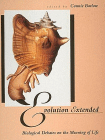
 Barlow,
Connie (Editor). Evolution Extended: Biological Debates on the Meaning of
Life. MIT Press, 1995. More information at Amazon
or FatBrain.
Barlow,
Connie (Editor). Evolution Extended: Biological Debates on the Meaning of
Life. MIT Press, 1995. More information at Amazon
or FatBrain.
For many years I have been leading Theology and Science seminars for Adult Education programs in Unitarian-Universalist churches. Bringing together some of the leading thinkers in cognitive science, physics, evolution, we address the impact of modern science on theological ideas. The basic premise is that everyone has a theological stance (Christian, Buddhist, Jewish, Muslim, Hindu, agnostic, atheist, humanist, etc.) and that this internal stance has often not evolved much since childhood, yet has a significant impact on our decision making. The goal is to get our theological thinking consistent with the latest advances in science (not all people are up to doing this).
1999 SeminarBarlow,
Connie (Editor). Evolution Extended: Biological Debates on the Meaning of
Life. MIT Press, 1995. More information at Amazon
or FatBrain.
"Creation Science" is a hot issue again. Actually, it has been since the time of Francis Bacon. It was heavily debated even before Darwin published his classic text. Chapter 10 of Barlow's book has everyone from the Pope to Stephan Jay Gould weighing in on the issue. It will form the basis of a two evening series in winter/spring 2000 at the Winchester Unitarian Society.
1998 Seminar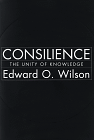
 Wilson,
Edward O. Consilience
: The Unity of Knowledge. Random House, 1998.
Wilson,
Edward O. Consilience
: The Unity of Knowledge. Random House, 1998.
"In his best-selling book, "Consilience" (Knopf, 1998), the Harvard biologist Dr. Edward O. Wilson tries to revive the Enlightenment dream of a unified system of knowledge that would embrace not only the sciences but also morality and ethics, removing them from the uncertainties of religion. Here the effort is not to make science spiritual but to make religion scientific." Johnson, George. Science and religion: Bridging the great divide. New York Times, 5 July, 1998.
Supplemental reading:
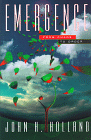
 Holland,
John H. Emergence
: From Chaos to Order. Helix Books, 1998.
Holland,
John H. Emergence
: From Chaos to Order. Helix Books, 1998.
Wilson's Consilience rests on the argument that the "mind is the brain at work," that what we perceive as consciousness is an emergent property of physical firing of neurons. Holland's book has a chapter on Neural Nets that is more satisfying than Wilson's chapter on Mind. It lays out some of the computer models that Wilson only alludes to.
A couple of years ago, we invited cognitive scientists to a seminar which reviewed the thinking of leading neurosurgeons and cognitive science. While the working hypothesis in cognitive science is definitely that "the mind is the brain at work," all presence confessed that they personally agreed with some of the great neurosurgeons of this century - there seems to be more to it that we do not understand.
1997 Seminar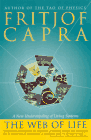 Capra,
Fritjof. The
Web of Life : A New Understanding of Living Systems. Anchor Books,
1997.
Capra,
Fritjof. The
Web of Life : A New Understanding of Living Systems. Anchor Books,
1997.
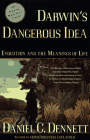 Dennett,
Daniel. Darwin's
Dangerous Idea: Evolution and the Meanings of Life. Touchstone Books (reprint
edition), 1996.
Dennett,
Daniel. Darwin's
Dangerous Idea: Evolution and the Meanings of Life. Touchstone Books (reprint
edition), 1996.
Other books of interest:
 Tipler,
Frank. The
Physics of Immortality : Modern Cosmology, God and the Resurrection of the Dead.
Anchor Publication, 1995.
Tipler,
Frank. The
Physics of Immortality : Modern Cosmology, God and the Resurrection of the Dead.
Anchor Publication, 1995.
 Gribbin,
John. Schrodinger's
Kittens and the Search for Reality : Solving the Quantum Mysteries. Little
Brown & Co, 1996.
Gribbin,
John. Schrodinger's
Kittens and the Search for Reality : Solving the Quantum Mysteries. Little
Brown & Co, 1996.
 Kauffman,
Stuart. At
Home in the Universe : The Search for Laws of Self-Organization and Complexity.
Oxford Univ Press, 1996.
Kauffman,
Stuart. At
Home in the Universe : The Search for Laws of Self-Organization and Complexity.
Oxford Univ Press, 1996.
Ferguson, Kitty. The Fire in the Equations : Science, Religion, and the Search for God. Wm B Eerdmans Pub Co, 1997.